The Science Behind Ceramic Heating Elements
Heat resistant materials and safety during operation are two important features people look for in a space heater.
Sep 28, 2026
Heat resistant materials and safety during operation are two important features people look for in a space heater.
If you’ve ever used one of the modern ceramic space heaters, or worked with industrial heaters, you’ve benefitted from clever use of materials science and solid state physics. Let’s dive in and explore how these heaters work, and what makes them different.
How Ceramic Heaters Work: Basics
Your typical ceramic space heater or industrial heater looks nothing like a thin metal wire. On the outside, they are often flat panels or chunks of solid material. Inside, they still follow the same basic rule that applies to all electric heaters.
Push enough current through anything that resists electrons and you will generate heat. This is sometimes called resistive heating or Joule heating.
PTC heaterstake that rule and refine it further. Not only can they generate heat, they can also self-regulate and produce even heat distribution. How do they do this? It all has to do with the materials used and how they behave.
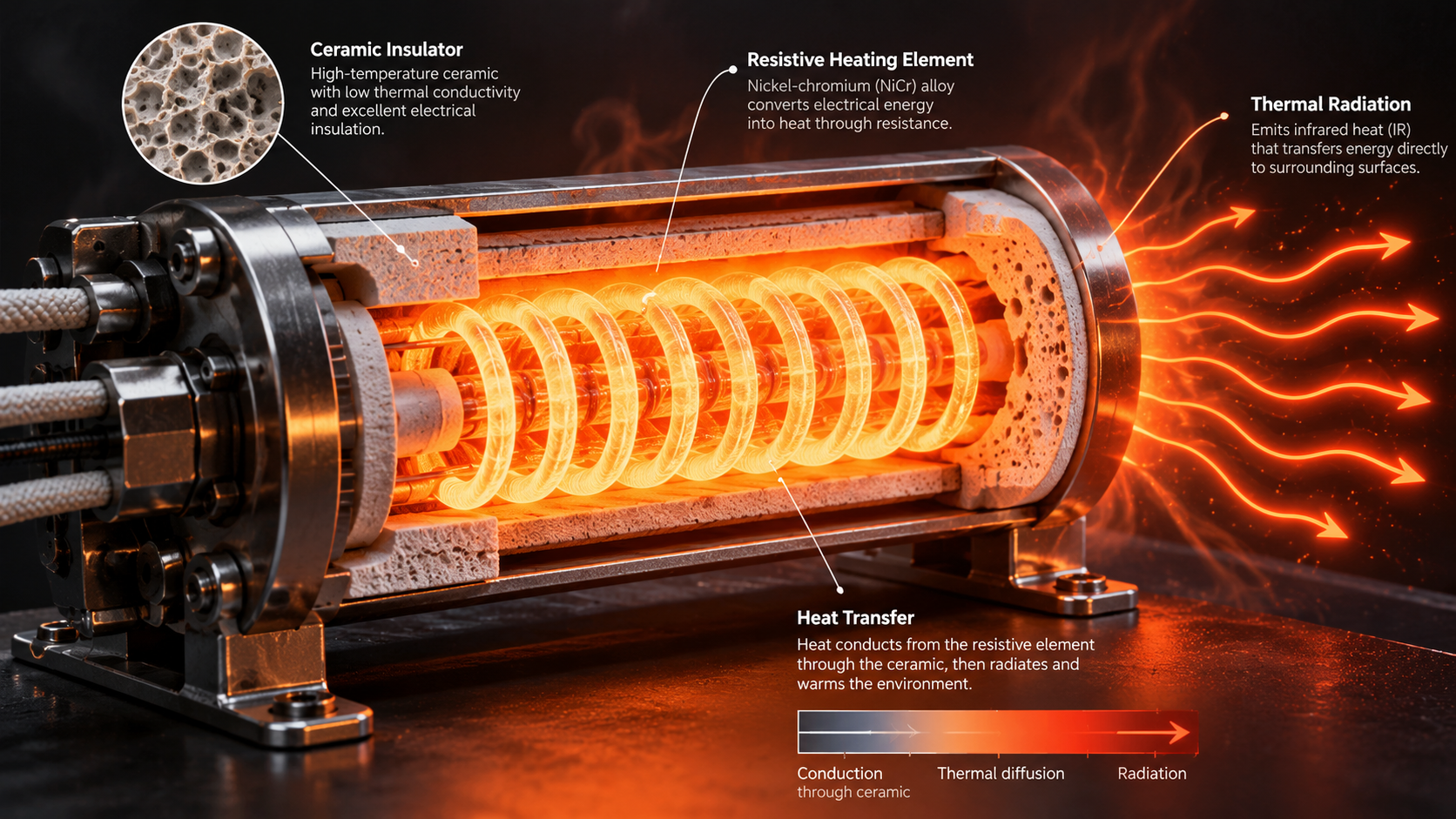
Electric heaters work using resistive heating. Electrical current travels through a resistive material and energy is lost as heat. On an atomic level, we can think of electrons moving through the substance and colliding with atoms and ions. Each collision will slow the electron down, and transfer energy to the entire lattice, heating it up.
The amount of heat produced depends on two things:
- The current passing through the element
- The resistance of the material
As you can see from the simple power equation above, if you provide a constant voltage, more resistance means less current, but more heat produced per amp of current. Heater designers use materials and geometry to set the resistance at the appropriate level to produce the desired amount of heat.
Ceramic heating elements work on the exact same principle. However, the materials involved bring additional properties that allow for more control over the process.
Understanding Ceramics
Most ceramics (think porcelain or alumina) are electrical insulators. This means that they do not conduct electricity well. However, certain advanced ceramics can be made semi conductive. These special ceramics can allow current to flow through them and exhibit strong temperature dependence of resistance.
Ceramic heating elements are made of materials that:
- Have sufficient electrical conductivity to allow current
- Provide predictable resistance vs temperature behavior over a useful range
- Withstand very high temperatures without melting
- Are resistant to chemical attack and thermal shock
Materials such as certain titanate ceramics, and other oxide compounds work well. These can sustain repeated thermal cycling without breaking down. This allows the heater to produce long life and dependable performance.
Finally, ceramics have excellent thermal properties. Not only can they conduct heat across their faces, they interact well with metal heat sinks/fins. This allows them to create uniform temps across the heater element.
Positive Temperature Coefficient
Perhaps the most useful scientific property of many ceramic heating elements is something called positive temperature coefficient, or PTC behavior. A material that has PTC behavior will experience increased resistance as temperature increases.
At low temperatures, the ceramic element has low resistance. Current flows through easily, and more heat is produced. As the temperature increases, the crystal structure begins to change. This reduces the number of charge carriers available, and suddenly resistance increases significantly over a range of temperatures. There are three big results of this change in resistance.
- Current flowing through the element at high temperatures is greatly reduced.
- Power output of the element decreases as temperature increases.
- There is a natural upper limit to the temperature the element can reach.
So, what we end up with if we run a heater at constant voltage is an element that essentially acts as its own temperature sensor. When cold, the element draws more power. When hot, it draws less. The unit will naturally settle at a temperature where the heat being generated is equal to the heat being lost to the surroundings. Hence the term “self-regulating heater.”
The PTC effect comes from certain features of the ceramic’s crystal structure and added dopants. However, at a certain temperature called the Curie temperature, something changes in the internal structure of the material.
Beyond this point, the ability for electrons to move freely is suddenly reduced. There is a sharp increase in resistance that keeps the element from heating much higher.
How Ceramic Heating Elements Produce Heat And Transfer It To The Surroundings
Of course, inside an actual heater, the ceramic heating element is only part of the system. While the element itself produces heat, the heater design will then transfer that heat to your room or process. Here is how it works.
- Electricity flows through the ceramic. When you turn on the heater, voltage is applied to either the ceramic directly, or to metal traces which have been embedded in the ceramic.
- Resistance heating happens. Since the ceramic material resists electron flow, collisions will occur. Each collision results in energy loss in the form of heat.
- The element reaches operating temperature. As heat builds up in the element, the temperature of the ceramic will rise. This continues until…
- PTC behavior kicks in. The resistance increases with temperature, limiting current, and stabilizing the temperature of the element.
- Heat is pushed into the surroundings. The now-hot ceramic face heats up a metal fin, plate, or heats the air directly. Heat leaves the element through conduction, convection, and radiation.
Elements are often manufactured in flat panels or disks. They may have printed resistor traces on them, contain wires embedded in the ceramic, or may even conduct directly through the ceramic. The thin profile helps to dissipate heat across a wider surface area. Heat spreads evenly across the element. A fan or natural convection then pushes that heat into your room or process volume.
Case Study: How Honeycomb PTC Ceramic Heating Works In A Real Application
The science behind PTC ceramic heating becomes easier to understand when you look at an actual heating application.
Pelonis Technologies has published a case study involving a customer that adopted its honeycomb PTC air-heating technology. The heating disc used in the application contains more than 1,200 small openings, allowing air to pass through the heated ceramic structure rather than simply moving around its outer surface. According to Pelonis, this design heats the airflow across the disc's surface area and can produce an airflow up to 50% hotterthan the conventional coil or ceramic-chip models it is compared against.
The design demonstrates an important principle in ceramic heater engineering: the heating element itself is only one part of the system. The way heat is transferred from the ceramic into moving air can have a major effect on the performance of the finished heater.
The honeycomb structure gives the airflow a large heated surface through which to pass. Instead of relying on a small hot spot, the design distributes the heating process across numerous channels in the ceramic. This is particularly useful in forced-air applications where a fan is moving air continuously through the heating assembly.
Pelonis reports that the customer continued using the honeycomb PTC heater in real-world applications and became a repeat customer. The company also states that the design required minimal routing and helped the customer save time and energy in its application. Those results relate to the specific customer application, however, and should not be interpreted as a guarantee that every PTC ceramic heater will deliver the same energy savings.
The case study also illustrates why ceramic heating technology is about more than simply choosing a material that can withstand high temperatures. The ceramic composition, electrical resistance, geometry, airflow, heat-transfer surface and surrounding heat exchanger all contribute to the final performance.
This is consistent with research and engineering work on PTC ceramic heaters. Fraunhofer IKTS notes that PTC elements are widely used in applications including automotive air heaters and household appliances, and explains that their characteristic resistance-temperature behaviour allows them to be self-regulating. It also points out that the ceramic element often needs to work together with metal heat exchangers to transfer heat effectively to the medium being heated.
In other words, the real engineering advantage is not simply ceramic versus metal. It is the combination of a temperature-dependent electrical material with a carefully designed method of transferring that heat where it is needed.
https://www.pelonistechnologies.com/honeycomb-ptc-air-heaters/case-study
Frequently Asked Questions About Ceramic Heating Elements
What Is A Ceramic Heating Element?
A ceramic heating element is an electrical heating component that uses a ceramic material to generate and transfer heat. Some ceramic heaters use semiconducting PTC ceramics whose electrical resistance changes significantly as their temperature rises. This property allows the element to regulate its power output as it heats.
How Does A PTC Ceramic Heating Element Work?
A PTC ceramic heating element generates heat through electrical resistance. When the element is relatively cool, its resistance is lower and more electrical current can flow through it. As its temperature rises, the resistance increases, reducing current and therefore reducing the element's power output. This temperature-dependent behaviour gives PTC heaters their self-regulating characteristic.
Why Is Barium Titanate Used In PTC Ceramic Heaters?
Barium titanate-based ceramics can be engineered to have a strong positive temperature coefficient of resistance. Around their characteristic transition temperature, their electrical resistance rises sharply. This makes the material useful for heating applications where the element needs to reduce its own power output as it becomes hotter.
Are Ceramic Heating Elements Safer Than Metal Heating Coils?
PTC ceramic heating elements can offer useful self-regulating characteristics, but it would be misleading to say that ceramic automatically makes a heater safe. Overall heater safety also depends on the electrical design, insulation, thermostat or control system, over-temperature protection, airflow, casing, installation and how the appliance is used. A ceramic element is one part of a complete heating system.
Do Ceramic Heating Elements Get Hot Enough To Heat A Room?
Yes. Ceramic heating elements can operate at temperatures high enough to transfer substantial heat to air. In a portable ceramic fan heater, the element is normally combined with a heat-transfer structure and fan so that air moves across the heated surfaces and carries the heat into the room.
What Is The Difference Between A Ceramic Heater And A Traditional Heating Coil?
A conventional heating coil normally uses a resistive metal wire whose resistance does not change dramatically with temperature. A PTC ceramic element, by contrast, has a strong temperature-dependent resistance. As the ceramic gets hotter, its resistance rises and the electrical power delivered to the element decreases. This gives PTC heating a degree of inherent self-regulation that a conventional fixed-resistance coil does not have.
Does A Ceramic Heater Use Less Electricity?
Not simply because it is ceramic. Both conventional electric resistance heaters and PTC ceramic heaters convert electrical energy into heat. A PTC heater's advantage is its temperature-dependent electrical behaviour and the way the heating system can be designed around it. Actual electricity consumption depends on the heater's power rating, operating time, thermostat control, room heat loss and other design factors.
What Are PTC Ceramic Heaters Used For?
PTC ceramic heaters are used in a wide range of applications, including portable space heaters, automotive cabin heating, air heaters, household appliances and industrial heating systems. Fraunhofer IKTS notes their use in automotive supply-air heaters and household appliances, while SAE has documented PTC ceramic technology being developed for vehicle compartment heating.
Final Words
To be fair, ceramic space heaters and industrial heaters aren’t magic. They rely on a unique mix of materials science and solid state physics to keep you warm and safe. At the heart of all ceramic heaters is the principle of resistive heating. Current applied to a resistive material creates heat. What makes ceramics special is that certain semi conductive ceramics have a positive temperature coefficient. Thanks to the wonders of science, you can grab your favorite space heater and enjoy the warmth!