Tester AI: Does It Actually Work For Detecting AI?
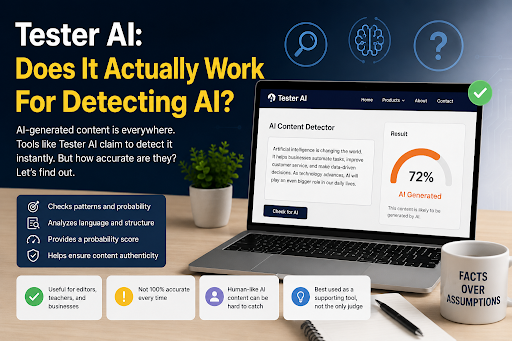
Tester AI is basically the latest tool everyone's talking about. It's supposed to detect AI-written content. You paste text into tester AI.
Jul 26, 2026
The Thing About Tester AI
Tester AI is basically the latest tool everyone's talking about. It's supposed to detect AI-written content. You paste text into tester AI. It tells you if a machine wrote it. Sounds useful right? I actually tested tester AI against a bunch of other tools. Results were mixed. Sometimes tester AI caught stuff. Sometimes it completely missed obvious AI.
This is what you need to know about tester AI before you start relying on it.
What's Tester AI Actually
Tester AI is software designed to identify when AI wrote something. The tool scans your text looking for patterns that AI typically produces. You know how ChatGPT has a certain style? Certain sentences structures it favors. Words it likes. Phrases it repeats. Tester AI tries to identify those patterns.
You throw text at tester AI. The software analyzes it. Compares patterns. Spits back results. Says something like "70% AI" or "completely human" or somewhere between.
It's basically the same as other detection tools honestly. Tester AI isn't revolutionary. Just another detector in a crowded market.
Why People Use Tester AI
Teachers use tester AI to catch students submitting ChatGPT essays. Main use case really. Publishers use tester AI to screen submissions. Don't want AI-generated articles in their publication.
Writers use tester AI on their own work. Check if something will get flagged. Companies use tester AI to verify writers aren't lazy. Make sure freelancers actually write stuff.
Students use tester AI to see if their writing triggers the detector. Plan around it. Content agencies use tester AI to spot-check contractor work. Verify quality.
How Tester AI Actually Works
Tester AI analyzes text statistically. Measures patterns. Checks word frequency. Looks at sentence structure and length. The software learns patterns from AI models. Compares your text to those patterns. Makes an educated guess about AI involvement.
Tester AI isn't finding proof. It's guessing based on patterns. That's an important distinction. The patterns exist for a reason. AI models do write differently than humans. But humans can write like AI. AI can write like humans. Tester AI can't always tell.
What Tester AI Actually Catches
Obvious AI output gets caught sometimes. Pure unedited ChatGPT text. Tester AI usually flags it correctly.
Edited AI content confuses tester AI. You take ChatGPT output and rewrite it? Tester AI might miss it completely.
Simple rewording defeats tester AI. Change word order. Use synonyms. Suddenly tester AI can't identify it.
Newer AI models are harder for tester AI to catch. GPT-4 sounds way more human than GPT-3.5. Tester AI trained on older models struggles.
Human writing that looks formal gets flagged by tester AI. Clear structured writing triggers it. Good vocabulary looks suspicious to tester AI. Non-native speakers get flagged constantly.
Real Problems With Tester AI
False positives happen constantly. Tester AI flags human writing as AI regularly. Studies show 15-25% of real human writing gets wrongly flagged by tester AI.
Students face real punishment. Teacher sees the tester AI flag. Assumes cheating. Student gets in trouble. They actually wrote it themselves.
False negatives happen too. Tester AI misses AI content frequently. Edited stuff gets missed. Rewritten AI passes as human to tester AI.
Different tools disagree. Test text against five different detectors including tester AI. Get five different results.
Tester AI says 80% AI. Another says 20%. Third says human. How do you trust tester AI if tools can't agree?
Accuracy Problems With Tester AI
Stanford tested detectors. Princeton tested them. Tester AI wasn't specifically tested but similar tools performed poorly. Best detectors hit around 60-75% accuracy. Tester AI probably similar. Barely better than coin flip honestly.
False positives and negatives happen too much. Tester AI isn't reliable enough for important decisions. Schools shouldn't use tester AI as only evidence. Courts shouldn't rely on it.
What You Actually Need to Know About Tester AI
Tester AI sometimes helps. Catches obvious AI. Not perfect though. Tester AI isn't accurate enough to trust completely. Works sometimes. Fails often. False positives hurt innocent people. False negatives help cheaters.
As AI improves tester AI becomes less effective. Not more. That continues. Detection can't catch up to generation. Gap keeps growing. Tester AI will struggle more over time.
Limitations of Tester AI
Content length limits are annoying. Tester AI caps how many words you can check. Maybe tester AI gives you 200 words free. Maybe 1000.
Monthly limits exist. Tester AI gives few checks then paywall. You want unlimited checks? Pay up.
Slower processing happens. Tester AI servers process slower than paid alternatives. Takes longer for tester AI to analyze.
Basic results only. Tester AI gives percentage. Not much explanation. Paid tools explain better.
Accuracy issues. Tester AI produces false positives constantly. False negatives too.
What You Should Actually Do
Don't panic if tester AI flags you. One tool flagging something means basically nothing. Students should ask teachers to verify. Have conversation about work. Don't accept tester AI result as proof.
Writers should appeal. Show you wrote it. Provide drafts. Show your process. Always combine tester AI results with human judgment. Never trust tester AI alone.
Using Tester AI Properly
Use tester AI as first pass only. Not final judgment. Tester AI might alert you to something. That's fine. Alert isn't proof. Text gets flagged by tester AI? Investigate. Read it. Ask questions. Check context carefully.
Teachers should use tester AI on student work then talk to students. Ask about their essay. Make them explain. Don't base consequences on tester AI alone. Publishers should use tester AI to screen then read content yourself. Judge it yourself. Tester AI is just one signal.
Everyone needs to accept tester AI fails. False positives happen. Misses happen.
Why Detection Gets Harder
AI keeps improving. Gets better at sounding human. Tester AI gets less effective. Tester AI must tell apart two increasingly similar things. Perfect human writing versus perfect AI-mimicked writing. Hard to separate.
As AI improves tester AI becomes less effective. Not more effective. That continues. Detection can't catch up. Gap keeps growing. Tester AI will get worse comparatively.
Better Alternatives
Actually read the content. Think about it. Judge quality. More reliable than tester AI. Talk to people. Ask them about work. Ask them explain. If they wrote it they can explain it.
Look for other signals. Does it match their skill level? Typos scattered throughout? Voice sound authentic? Ask for drafts. Brainstorming. Research process. Faking all that is way harder than faking output.
The Honest Truth
Tester AI sometimes helps. Sometimes catches obvious AI. They're not perfect. Tester AI isn't accurate. Works sometimes. Fails often. False positives hurt innocent people. False negatives help cheaters.
As AI improves tester AI gets less effective. Not better. That continues. Use tester AI as one signal only. Never sole basis for decisions. Arms race between AI and detection continues. Detection losing. Accept tester AI has real limits.
Pair any tester AI result with human review. Verify yourself. Think critically. Trust your judgment more than tester AI. The bottom line? Tester AI is helpful sometimes. Just don't rely on it completely.
Understand the limitations. Use tester AI as supporting information. Get human confirmation if something matters. That's really what you need to know about tester AI and how it actually works.